
Patterns
The everyday stack,
rebuilt to prove itself.
Every product is built from the same few parts: an identity, an inbox, a team, a vault for its secrets, a log. Today each part is a service you trust. The bstack pattern series rebuilds them, one brief at a time, so the data defends itself: any reader checks it, any host can serve it, and your users ride free. Read them in sequence; each one builds on the last.
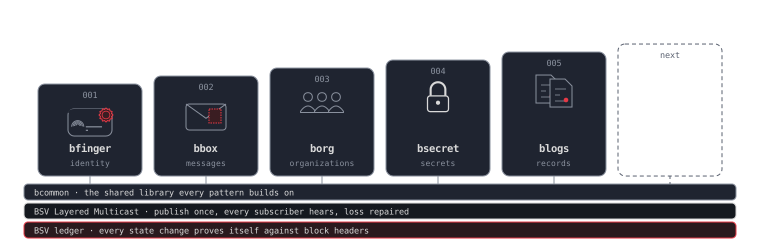
Three ideas, every pattern
The applications differ; the foundation does not. That is why each pattern is smaller than the one before it would have been on its own, and why they work together.
State proves itself
Every change is a Bitcoin SV transaction, signed by its owner and anchored in a ledger nobody can rewrite. Only a few hundred bytes are mined; the data rides beside them, provable always and retractable by its owner.
Publish once
BSV Layered Multicast delivers each publication once to every host subscribed to it, at the same moment, with loss repaired by the network. Adding the hundredth host adds nothing to the publisher's side.
Readers verify, hosts compete
Readers check every answer against block headers they hold themselves, so a host is a replaceable service, never the keeper of the truth. Operators compete on service, and customers can always leave.
The series
Numbered in reading order. Each brief explains the problem, what the pattern does, how it works, why it is new, how BSV Layered Multicast scales it, and its honest limits, for developers and decision makers alike.
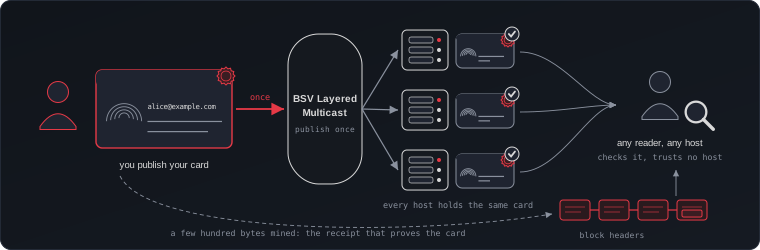
bfinger: a name that proves what it says
Ask what alice@example.com currently says about
itself and get an answer that proves itself, from any host,
checked on your own machine. A self-published identity and
status record with real retraction, payable from the identity
that just proved itself. Live on the BSV mainnet.
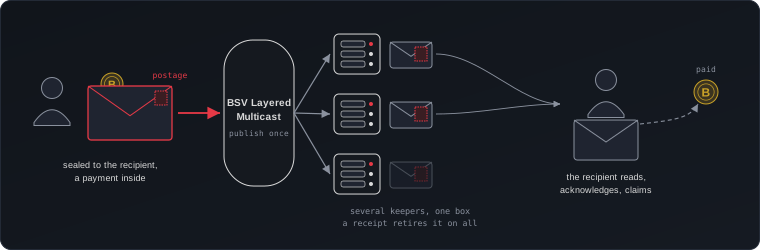
bbox: a mailbox with many keepers and a payment inside
Envelopes sealed to one recipient, bound to their sender, priced by postage built into their structure, kept by several independent hosts and retired everywhere by one signed receipt. A payment travels inside and settles when the recipient claims it.
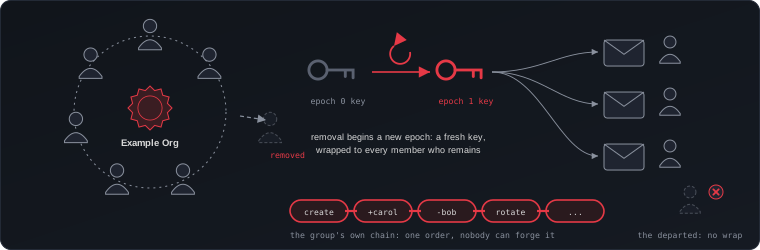
borg: teams whose keys change when someone leaves
Membership as certificates one spend revokes for every verifier, every group change on the group's own chain in an order nobody can forge, and a group key that every host insists is replaced the moment anyone is removed.
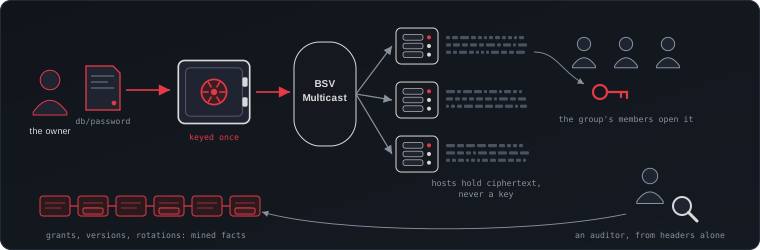
bsecret: a vault whose hosts never hold a key
Secrets kept on hosts that hold ciphertext and never a key. Readers are the members of a borg group, removal forces a re-key that every host enforces, and the whole trail of versions and rotations is checked by an auditor against block headers alone.
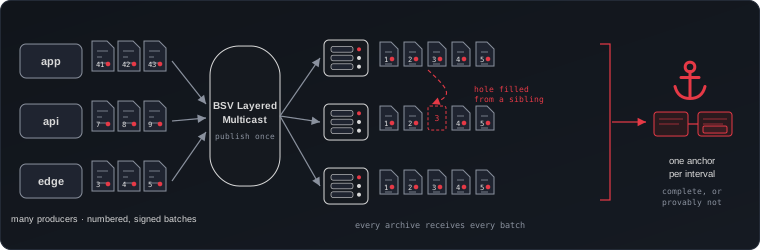
blogs: a log with a witness nobody controls
Producers append signed, numbered batches; every archive receives each one at the same moment; one small anchor per interval lets any archive prove its copy complete and any auditor prove when a line was committed. Many producers, no coordinator.
Every pattern in the series draws on one pattern language, set out in full in The bstack: publish once, prove everything, and let users ride free (Paper 009), with a plain-language overview for readers new to the idea. The delivery layer is an open standard: the overlay object plane is published as BRC-148 and BRC-149 on the Standards page and explained in The overlay object plane. Every pattern also runs over plain point-to-point connections; the network is what makes distribution reliable and global.
Build on 1BSV
Your users ride free: publishing into the network is never billed. Hosts pay only for what is delivered to them. The overlay lane is in early access.